You already train. You already sleep. And your physique still looks like a rough draft, because the third input, food, is running on improvisation. You eat when hungry, order when tired, and call the random pile of calories “eating for gains” or “eating clean,” depending on your mood that week.
Here is the counterintuitive part: your problem is too much variety. The guys with the best physiques eat a boringly small rotation of meals, decided in advance, cooked in batches. Spontaneity feels like freedom. In practice it means every meal is a negotiation you lose at 11 pm in front of the fridge. Fuelmaxxing is the fix: eating treated as an operating system with a few inputs, a schedule, and almost zero daily decisions.
Rule One: Protein First, Everything Else Second
Every physique goal, muscle gain or fat loss, runs on the same foundation: hit your protein number daily. Calories decide whether you grow or shrink. Protein decides what the new tissue is made of. Miss protein and a bulk builds fat while a cut burns muscle. Simple, brutal, ignored by almost everyone.
The target: 1.6 to 2.2 grams per kilogram of body weight per day. That is 0.7 to 1 gram per pound. Use the low end for cutting (protein needs rise in a deficit), the high end if you like round numbers and easy math.
Worked examples, so you never have to think again
// The protein math
- 65 kg (143 lb): target 130 g/day. That is 4 eggs (24 g), 200 g chicken breast (62 g), a scoop of whey (25 g), and 150 g Greek yogurt (15 g). Total: 126 g. Close enough, done.
- 80 kg (176 lb): target 160 g/day. Same menu plus an extra 150 g of chicken or a second whey shake. You are a two-scoop man now.
- 95 kg (209 lb): target 190 g/day. The 80 kg plan plus a can of tuna (30 g) and a cottage cheese bowl (25 g). Bigger frame, bigger line item.
Notice the pattern: every plan is the same four or five foods in different quantities. That repetition is the system doing exactly its job.
One serving rule that saves you from label-reading madness: a palm-sized portion of meat or fish is roughly 25 to 30 g of protein. A fist of Greek yogurt or cottage cheese is 15 to 20. Count palms and fists for two weeks and you will estimate protein by eye for the rest of your life.
Two rules keep the target alive on bad days. First, spread it: 3 to 4 meals of 25 to 40 g each beat one heroic dinner, because muscle building runs in batches and a single 150 g sitting mostly gets burned for fuel. Second, keep an emergency fix on the shelf: if 9 pm rolls around and you are 40 g short, two scoops of whey in water is 50 g in ninety seconds. That shake turns a missed day into a rounding error.
Low appetite is the usual excuse for missing protein, and it is a scheduling problem in disguise. Front-load the day: 40 g at breakfast makes the rest of the target happen almost by accident. The guy who says he cannot eat that much is the guy who skipped breakfast and tried to cram 120 g into one dinner.
You cannot out-train a fridge you improvise in front of.
The Twice-Weekly Meal Prep Operating System
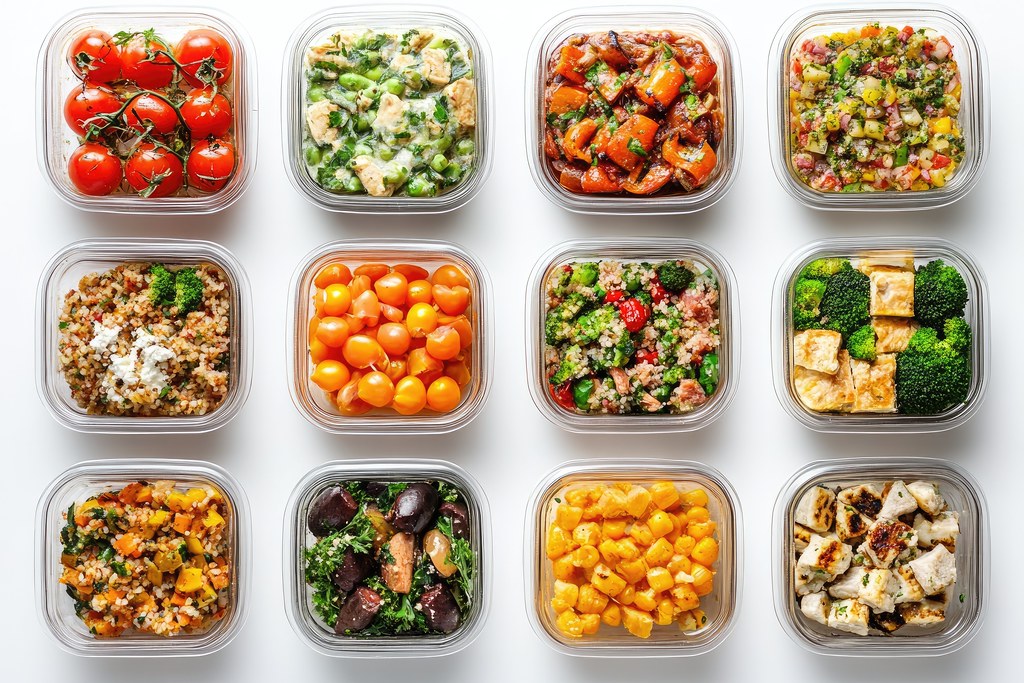
Daily cooking fails because it asks for willpower 21 times a week. Batch cooking asks for it twice. Cook on Sunday and Wednesday, roughly 90 minutes each session, and every meal for the next three to four days is a reheat away. The fridge becomes a vending machine that only stocks good decisions.
The shopping list, by category
The cook sequence
// The 90-minute cook window
- Minute 0: Oven on at 200 C. Rice cooker on with 4 cups of dry rice. Both run unattended from here.
- Minute 10: Season all the meat, sheet-pan it, into the oven. Potatoes on the second tray.
- Minute 20: Brown the ground meat in a pan while the oven works. Boil 8 eggs in a second pot.
- Minute 40: Microwave-steam the frozen vegetables. Portion everything into containers: protein plus carb in each, vegetables and sauce added at eating time so nothing gets soggy.
- Minute 70: Containers in the fridge, front row for the next two days, back row for days three and four. Kitchen cleaned once, not seven times.
Storage is simple: cooked food keeps 3 to 4 days in the fridge, so the Sunday batch covers Monday to Wednesday and the Wednesday batch covers Thursday to Sunday. Anything longer goes in the freezer. Glass containers survive years of this. Plastic survives months and stains like a crime scene.
Bulk, Cut, or Maintain: the Decision Tree
Most guys pick a phase based on vibes: felt soft after the holidays, cut. Watched a Ronnie Coleman video, bulk. Phases chosen by mood last about eleven days. Choose with three measurements instead, taken monthly on the same morning:
// The monthly audit
- The tape: waist at the navel, first thing in the morning, relaxed. The one number that never lies about fat gain.
- The mirror: front relaxed photo, same lighting, same spot. Compare month over month, never day over day.
- The logbook: are your main lifts moving up, stalling, or dropping?
Now the tree:
- Waist under control and lifts stalling: lean bulk. Add 200 to 300 calories per day above maintenance, mostly carbs around training. Aim for 0.25 to 0.5 kg gained per month. Faster than that is fat wearing a costume.
- Waist creeping up (plus 2 cm over two months) and lifts fine: cut. Subtract 400 to 500 calories per day, keep protein high, lose 0.5 to 1 percent of body weight per week. Lifts should hold roughly steady. Strength crashing means you cut too hard.
- Waist stable and lifts climbing: maintain. You found the sweet spot. Change nothing and let the months stack.
- Waist up and lifts down: you are eating like a bulk and recovering like a cut. Fix sleep and protein first, hold calories at maintenance, re-audit in four weeks.
Run each phase for a minimum of 8 to 12 weeks before switching. The mirror moves on a lag of about three weeks behind your habits, so weekly course corrections are just noise with extra steps.
// From The BossMaxx Protocol
The audit tells you which phase to run. The fuel chapter of The BossMaxx Protocol hands you the rest: calorie tables by body weight, the 30-day build order that installs food in week one so training and focus run on a full tank, and a tracker that logs waist, lifts and protein on one page.
Eating Out Without Losing the Plot
A system that breaks at a restaurant is a hobby, and social meals are where physiques go to negotiate. The fix is a three-step default you run every time, no willpower required:
- Before: eat your protein anchor at home. A whey shake or a Greek yogurt bowl an hour before you go out kills the arrive-starving problem, which is the actual reason restaurant meals go sideways.
- During: order by formula: a protein main, a carb side, vegetables where possible. Steak and potatoes, grilled fish and rice, double-patty burger. Then eat slowly and stop at full. The bread basket and the second round of drinks are optional levels, not main quests.
- After: the next meal is a normal system meal. One restaurant dinner is 800 to 1,200 surplus calories at worst, which a week of the system absorbs without a trace. The damage was never the meal. The damage is the three-day “I already blew it” spiral that follows it.
Two field fixes for the failure modes that actually happen. Chaotic menu, no obvious fit: default to the double burger or any grilled chicken plate, water or diet soda, done. Nobody at the table will notice you ordered with a system. Drinks happening: cap at two, pick spirits with soda or a light beer, because cocktails are milkshakes that lie about it.
Frequency check: if you eat out more than three times a week, the restaurant is your diet and the meal prep is the exception. Flip that ratio before optimizing anything else.
The 80/20 Rule That Makes It Permanent
Here is the part that keeps this running for years instead of weeks: 80 percent of your intake comes from the system, 20 percent is unstructured, and the 20 percent is planned in advance. That is roughly four free meals a week. Pizza Friday, birthday cake, the weird thing your friend insists you try. Planned indulgence has no guilt tax and no rebound binge, because nothing was broken.
Define the free meal precisely or it eats the system: one sitting, one plate, dessert if you want it. A free day is a binge with better branding. And when a week goes sideways and you blow past 20 percent, skip the punishment week. The next week is a normal 80/20 week. The system forgives by default, which is exactly why it is still running in year two.
The 80/20 split sounds like a compromise. It is actually the mechanism. Diets fail at the point of total restriction, usually around week six, in a dramatic way that erases the six weeks. A system with a built-in release valve has no pressure to blow. Boring 80 percent of the time is what makes the fun 20 percent free.
The 14-Day Fuel Setup
// Community quest
Fourteen days to install the system. Four rules:
- Rule 1: Calculate your protein target today and hit it every day. Round numbers allowed, zero days off.
- Rule 2: Two batch cooks per week, Sunday and Wednesday, 90 minutes each. Calendar entries, non-negotiable.
- Rule 3: Four free meals per week maximum, and each one gets planned before noon that day.
- Rule 4: Waist measurement and mirror photo on day 1 and day 14, same morning conditions.
Track two numbers: days at protein target (out of 14) and batch cooks completed (out of 4). Fourteen straight days of decided-ahead eating, and you will understand why the leanest guys you know all eat the same lunch.
Today, do the one thing that starts the whole machine: weigh yourself, multiply by 2 for your protein target in grams, and write down the four or five foods that get you there. That short list is your eating system, and day one of it is tomorrow’s breakfast.